
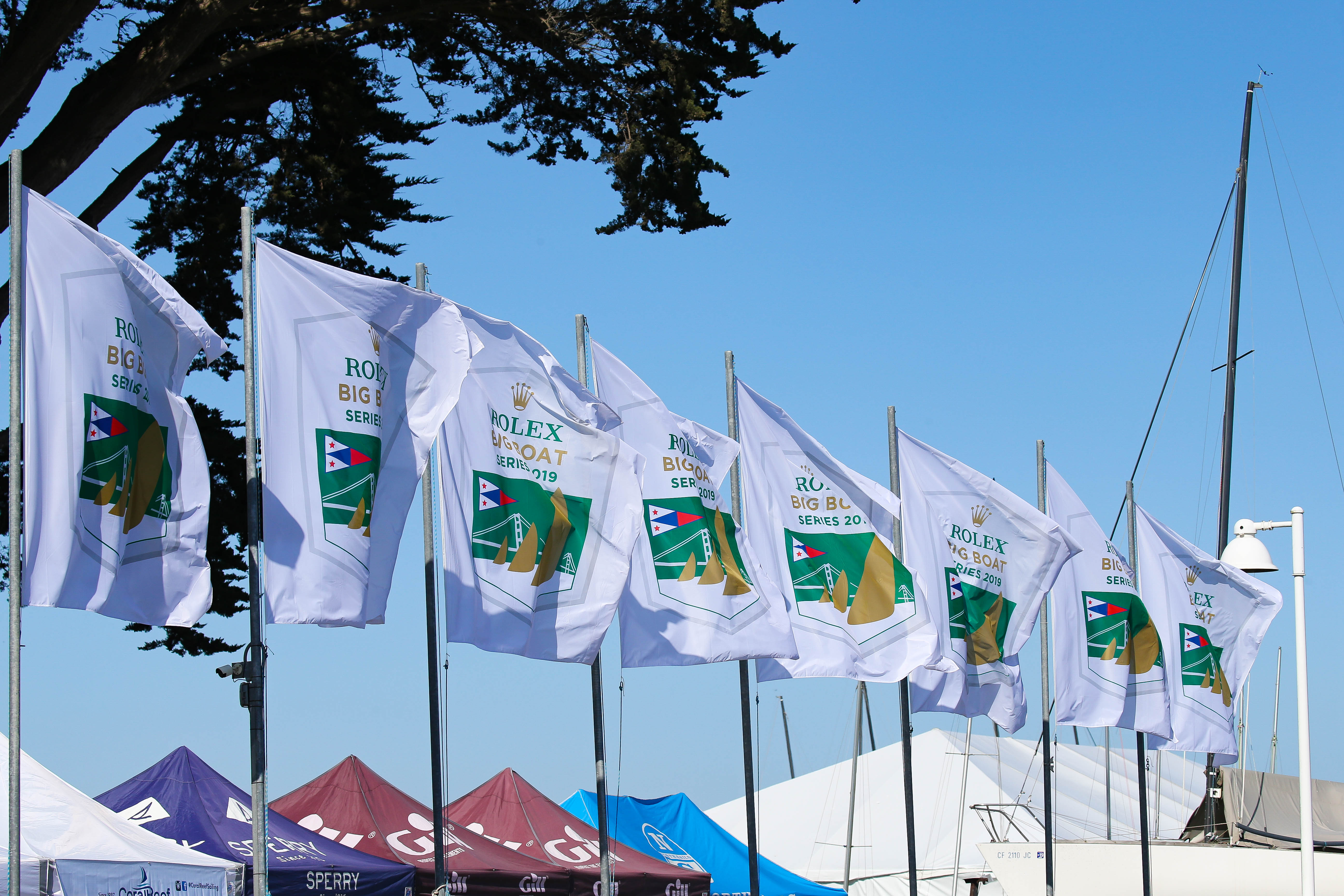
War is inevitably messy, but few battlegrounds are as civilized as St. Francis Yacht Club and its docks on the eve of the 55th edition of its annual Rolex Big Boat Series (September 11-15, 2019), where 79 polished teams and racing yachts have gathered on the waters of San Francisco Bay to trade nautical fisticuffs and determine dockside bragging rights. But once the starting guns begin sounding for tomorrow’s first race, all sailors—from uninitiated midbowmen to seasoned skippers—will coat-check their yacht-club politesse for favorable starting-line positions, passing-lane opportunities and the chance to have their names etched onto the perpetual trophies of the West Coast’s most competitive regatta. But first, of course, winning teams must stave off many of the country’s fastest guns on a historically windy and always-tide-torn racecourse.
Not surprisingly, pre-race tensions abound at this Grand Prix-level regatta, where no one cherishes also-ran status.
“There’s a little pressure to give her the best chance she can have,” said Chip Merlin, owner and skipper of Merlin (USA 8955), the Bill Lee-designed 68-foot sled that first redefined offshore racing in 1977, and which Merlin (fittingly) acquired in late 2017. “We know she’s very fast in light air, and this will be a test against some very stiff competition in heavier air and around marks. We could get crushed or we can win—you never know until you put yourself out there and try. It will be fun regardless.”
While Merlin explained that he upgraded Merlin well ahead of this year’s Rolex Big Boat Series, other skippers plan to leverage hard-won lessons from previous years’ experience.
“We started our preparations for this year's Rolex Big Boat Series before last year's regatta was even completed,” said Dave MacEwen, owner and skipper of the Santa Cruz 52 Lucky Duck (USA 28729), adding that while the team enjoyed good off-the-breeze speed last September, they struggled to stay in the hunt when the winch drums started squealing. “I think we’ll have a new upwind gear for this year's regatta,” he said, explaining that the team changed their sail inventory and rig setup to improve their upwind metrics. “We look forward to mixing it up with some of the West Coast’s best competition at one of the world’s best sailing venues, and of course, we look forward to StFYC’s incredible hospitality.”
While Lucky Duck has been optimized for StFYC’s signature Rolex Big Boat Series, other owners take different tacks. “We keep the boat ocean-rigged, even at the Rolex Big Boat Series as that's what we want to keep the crew focused on,” said Michael Moradzadeh, owner and skipper of the Santa Cruz 50 Oaxaca (USA 8927). “Fortunately, the Rolex Big Boat Series’ Race Committee obliges the big boats by giving us courses that are long enough to let us stretch our legs between mark-roundings.” As for items from his offshore inventory that may prove tactically valuable on San Francisco Bay, Moradzadeh thinks symmetrically. “We may carry a couple square kites in case we actually want to sail deep, deep downwind,” he said.
This may well prove to be a smart strategy, given the sheer number of courses that are available. “This year in particular, we’re focused on giving quality windward/leeward courses for our One Design classes, while offering up a total of six different ORR ratings to maximize the competitiveness in the handicap classes,” says Graham Biehl, StFYC’s Race Director. “We have an enormous list of courses available to us to accommodate all the different types of boats and wind conditions we expect.”
Biehl will be working with the highly respected team of Peter Reggio and Jeff Johnson, who are serving as the regatta’s Principal Race Officers.
One big change to this year’s racecourse aesthetics will be the inclusion of the Classics class, which is populated with five yachts that were built before 1955 and measure at least 48’ LOA. “Many of us have sailed aboard friends’ boats in France, England, and the Caribbean during the established classic-yacht regattas in those areas, and we have returned home convinced that we should bring top-tier classic-yacht racing to San Francisco Bay,” said Beau Vrolyk, owner and skipper of Mayan (1947), a 59-foot Alden-designed schooner that was built in 1947 and was previously owned by David Crosby of Crosby, Stills, Nash and Young fame. “The Rolex Big Boat Series is the perfect event to showcase our growing fleet of beautiful boats.”
Speaking of things that are built to last, Rolex has long been a strong supporter of high-level sailing, and the 55th annual Rolex Big Boat Series marks the horological firm’s 14th year of sponsorship of this iconic regatta. This unflinching commitment is reflected in the four gleaming Rolex Submariner Date timepieces that will be awarded at Sunday’s Trophy Ceremony, which is set to unfurl on StFYC’s East Marina Lawn at 1600 hours.
This year, the 23-strong J/105 class will be competing for the Commodore’s Cup, which is awarded to the class with the largest one-design fleet, while the ORR A class will be racing for the St. Francis Perpetual Trophy. The ORR B will battle for the City of San Francisco Perpetual Trophy, while the ORR C class will be vying for the Richard Rheem Perpetual Trophy. Those four trophy winners will each wear home a Rolex Submariner Date timepiece.
“Rolex isn’t just a sponsor but a valuable partner in hosting an amazing regatta,” said Susan Ruhne, Regatta Chair for the 55th edition of the Rolex Big Boat Series. “RBBS competitors look forward to the opportunity to win a Rolex timepiece here.”
Additionally, Rolex Big Boat Series has achieved Platinum Clean Regatta status, the highest-level achievable with Sailors for the Sea, the world’s only sustainability certification for water-based events. This was possible, in part, by partnering with West Marine who is supporting the regatta as the event’s official Sustainability Sponsor. West Marine will be supplying the Rolex Big Boat Series with two water-bottle refilling stations and refillable bottles, the latter of which will be given to teams on an as-needed basis (so as not to give more plastic to people who already own refillable bottles). In all cases, the goal of these water stations is to dramatically reduce the volume of single-use plastics that the event generates.
Racing for the 55th annual Rolex Big Boat Series is set to begin tomorrow, September 12, at 1100 hours. Conditions-depending, StFYC’s Race Committee aims to score two races per day for the regatta’s first three race days of racing, while Sunday has historically featured a single long-form Bay Tour course that rewards shore-based spectators with exciting downwind finishes right off of StFYC’s Race Deck.
Please visit www.stfyc.com for the latest news about this world-class regatta, as it unfurls.
Rolex and Yachting
A natural and supportive partner
Rolex has always sought to associate with activities driven by passion, excellence, precision and team spirit, naturally gravitating towards the elite world of yachting and forming an alliance that dates to the late 1950s. Today, Rolex is Title Sponsor of 15 major international events; from leading offshore races, such as the Rolex Sydney Hobart Yacht Race, Rolex Middle Sea Race and the biennial Rolex Fastnet Race, through to the highest-level grand prix competition at the Rolex TP52 World Championship and spectacular gatherings at the Maxi Yacht Rolex Cup and the Rolex Swan Cup. The Swiss watchmaker’s close partnerships with the most prestigious yacht clubs around the world, including the Cruising Yacht Club of Australia, Yacht Club Costa Smeralda (Italy), New York Yacht Club (United States), the St. Francis Yacht Club (United States) and the Royal Yacht Squadron (Cowes, United Kingdom), are the foundation of its enduring relationship with this spectacular sport.
About Rolex
An unrivalled reputation for quality and expertise.
Rolex, a Swiss watch manufacturer headquartered in Geneva, is recognized the world over for its expertise and the quality of its products. Its Oyster and Cellini watches, all certified as Superlative Chronometers for their precision, performance and reliability, are symbols of excellence, elegance and prestige. Founded by Hans Wilsdorf in 1905, the brand pioneered the development of the wristwatch and is at the origin of numerous major watchmaking innovations, such as the Oyster, the first waterproof wristwatch, launched in 1926, and the Perpetual rotor self-winding mechanism invented in 1931. Rolex has registered over 500 patents in the course of its history. A truly integrated and independent manufacturing company, Rolex designs, develops and produces in-house all the essential components of its watches, from the casting of the gold alloys to the machining, crafting, assembly and finishing of the movement, case, dial and bracelet. Through philanthropic programs and a broad palette of sponsorship activities, Rolex is also actively involved in supporting the arts, sports and exploration, and encourages the spirit of enterprise, as well as the conservation of natural environments.
About St. Francis Yacht Club
St. Francis Yacht Club was founded in 1927 and has been host to many of the most prestigious national and international championships in sailing. With over 40 regattas on its calendar annually, StFYC is widely regarded as having one of the top racing and race management programs in the country. In addition to enjoying a worldwide reputation for on-water excellence, Platinum Clubs of the World named the St. Francis Yacht Club the Number One Yacht Club in the United States in 2012, 2014, 2016, and 2019 and Boardroom Magazine recognized it as the first yacht club to be a Distinguished Emerald Club of the World.
For more information, please visit the Rolex Big Boat Series' website.
Sailors For The Sea
Rolex Big Boat Series is a certified Platinum Level Clean Regatta, and all of the regattas hosted by St. Francis Yacht Club meet or exceed Gold Level Clean Regatta status from Sailors for the Sea, the world's only sustainability certification for water-based events. St. Francis Yacht Club utilizes a voluntary, self-assessment tool to benchmark its environmental footprint with goals for reducing waste generated by the event and continuously improving the long-term sustainability of the club and the environment.
